

 SK
 F4
 W3
 MC
 ETS2
 AC

Cyberpunk 2077 · Visual effect
Cyberpunk 2077 clearer color mods
Clearer color mods remove part of the yellow and green tint Cyberpunk 2077 puts over daytime scenes, cut back the haze over the Badlands and change tone mapping so whites stay white. Start with the in-game film grain, chromatic aberration and HDR options, since they explain a lot of the muddy look on their own.


01Part 1 of 6
Why do Cyberpunk 2077 colors look yellow or muddy?
Cyberpunk uses heavy color grading as part of its style. Daytime in Watson and the Badlands has a warm yellow and green cast, a thick haze softens distant buildings, and the default tone mapping keeps highlights from getting really bright. On a good HDR screen this can look intentional. On many SDR monitors it reads as dull.
What people usually describe
A yellow wash in daylight,
most visible on concrete, skin tones and clear skies around midday.
Gray blacks
in interiors, where the darkest areas never quite reach black.
Haze in the distance,
so the skyline from the Badlands looks low contrast.
Soft image overall,
from film grain, chromatic aberration and depth of field stacking together.
Clipped highlights
in HDR when peak brightness or paper white is set wrong for the display.
Some of this comes from settings, some from the grading itself. A color mod can only fix the second part. It is worth checking the first part before downloading anything.
Screens
See the difference
The same scene before and after, plus the spot we test this effect in.
- In gameDistant skyline views show how much haze the default weather adds.
- BeforeThe base game look.
- AfterWatson at midday: the default yellow cast and haze compared with neutral grading and less distant fog.
03Part 3 of 6
How do Cyberpunk 2077 color mods change the image?
There are three main ways color mods work, and they differ in how deep they go.
Color grading edits. The game applies color lookup tables, often called LUTs, that shift colors depending on the area, weather and time of day. Mods that replace or neutralize these remove the yellow and green tint at the source. Because they work inside the engine, the UI is left alone and the change follows you everywhere.
Tone mapping and exposure changes. Tone mapping decides how the bright and dark values the game renders end up on your screen. Mods here can let whites reach full brightness, deepen blacks and stop highlights from going flat.
Fog and haze reduction. Atmospheric haze is part of the weather data. Less haze gives a sharper skyline but can make the city look smaller, since the haze also adds a sense of distance.
ReShade presets apply color correction to the finished frame. They are easy to toggle and tune live. The downside is that they also affect the HUD and menus, and they cannot tell a hazy sky from a gray wall. For a deeper look at the difference, see ReShade vs ENB explained. Cyberpunk has no ENB, but the same in-engine vs post-process split applies.
04Part 4 of 6
Where should you compare Cyberpunk 2077 colors before and after?
Color changes look different in every district, so check a spread of places at fixed times. Use photo mode for still frames.
Watson streets at noon
Where the yellow cast is strongest. Look at concrete and skin tones.
The Badlands in late afternoon
Haze and warm light. Shows how far you can see and whether the sky stays natural.
Corpo Plaza on a clear day
Glass and white surfaces. Good test for clipped highlights.
Your apartment in Megabuilding H10
A familiar interior for black levels and indoor color.
A dialogue scene
Character faces show quickly whether a color change looks natural or makes people orange or gray.
Night in Japantown
Even if you only want to fix daytime, check that night neon still looks right after the change.
Look at the same screenshots on a phone or second screen too. If a change only looks good on one display, it is probably compensating for that display rather than fixing the game.
05Part 5 of 6
Do color mods work with lighting and weather mods in Cyberpunk 2077?
They can, but they overlap more than people expect. Color, lighting and weather all live close together in the game data.

Lighting mods often include their own grading or exposure changes. Adding a separate color mod on top can double the effect: shadows too dark, saturation too high. If your lighting mod already changes colors, try it alone first. See night lighting for how those mods affect exposure.
Weather mods often set haze and fog per weather state. A color mod that reduces haze may be overridden by the weather mod, or the other way around, depending on load order. Read load order and mod conflicts if two mods seem to cancel each other out.
ReShade with an in-engine mod works well if the preset is light. Use it for a small contrast change or sharpening, not a second full grade.
HDR users should be careful with color mods made for SDR, because the tone mapping is different. Some mods offer separate SDR and HDR versions.
BOMZA does not currently sell a Cyberpunk pack aimed at this topic. For free options, see free mods.
06Part 6 of 6
Do Cyberpunk 2077 color mods lower FPS?
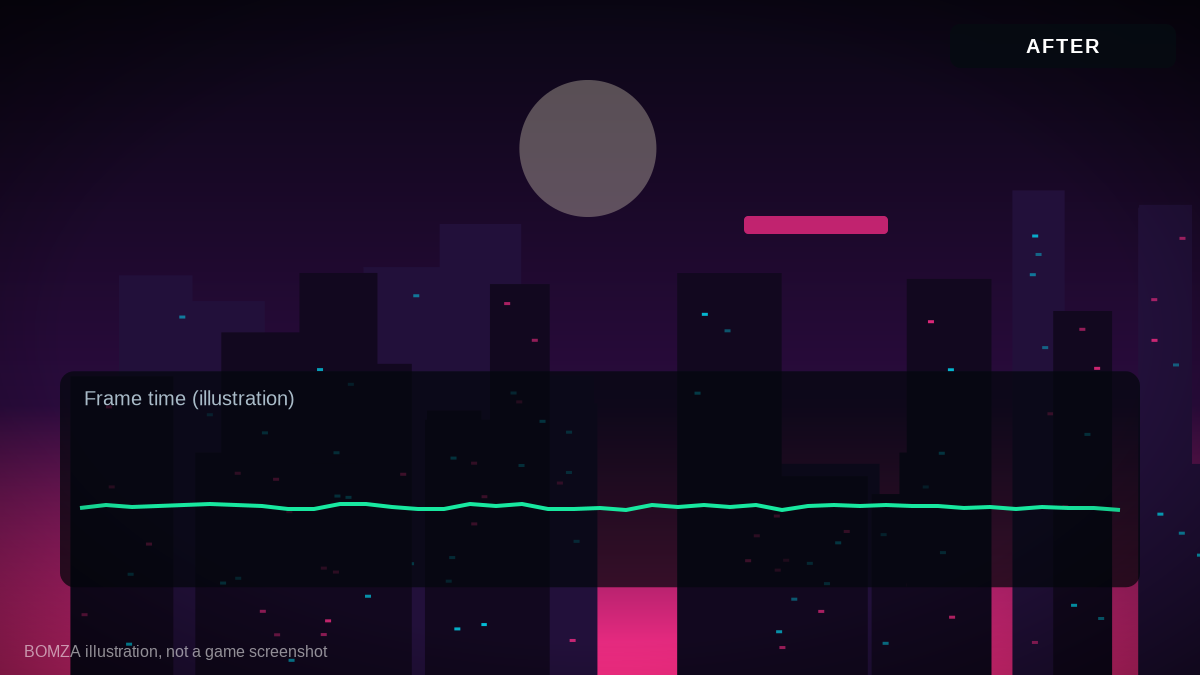
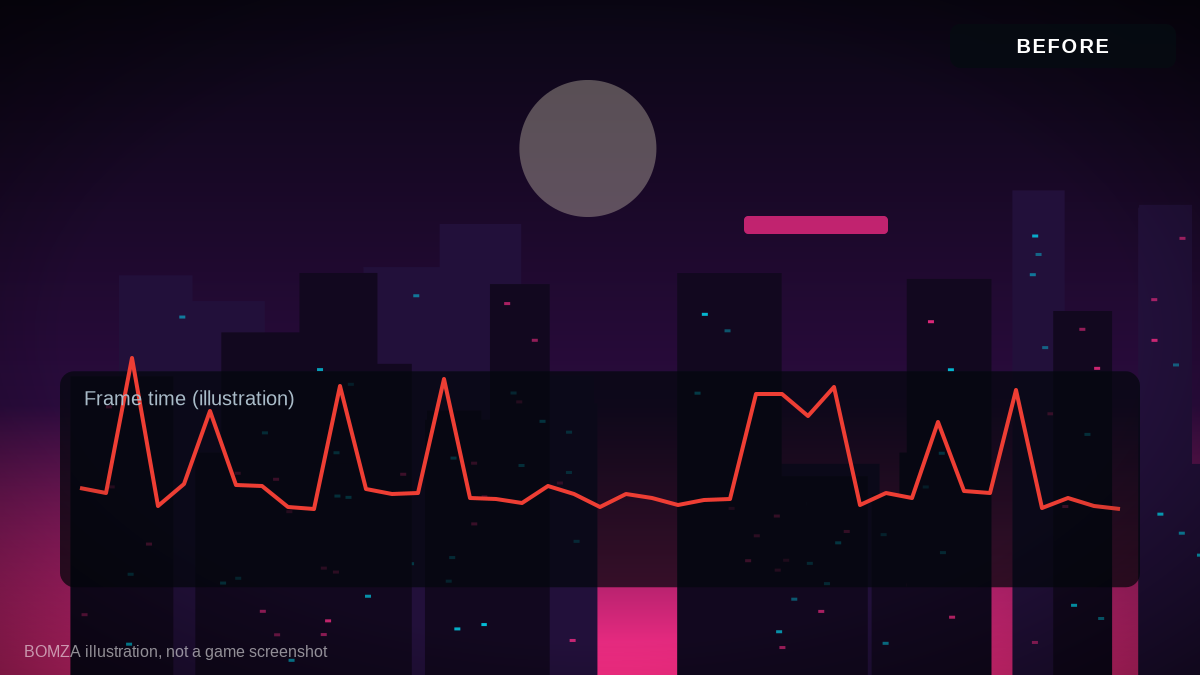
In-engine color changes cost very little. Swapping a color lookup table or changing tone mapping values does not add work for the GPU. Turning off film grain, chromatic aberration or depth of field can even give back a small amount of performance.
Haze and fog changes can go either way. Less fog is usually cheaper. Mods that make fog more detailed or volumetric cost more.
ReShade is the part to watch. A preset with only color correction and light sharpening is cheap. Presets that include ambient occlusion, depth of field, global illumination style shaders or heavy bloom can cost a lot, especially at high resolution, because they run extra passes on every frame. Look at the list of active shaders in the ReShade overlay and switch off the ones you do not need.
Test with the same route and settings, before and after. Our method is described in how BOMZA measures FPS impact. For settings that give back frames, see Cyberpunk 2077 FPS boost.
Dial it in
Settings that change the look
- 01
Color grading strength
Controls how much the area and weather tint is applied. Lower values remove the yellow and green wash in daylight.
- 02
Tone mapping curve
Changes how bright and dark values reach your screen. A different curve lets whites reach full brightness and blacks go deeper.
- 03
Haze and fog density
Sets how much atmospheric haze sits between you and distant buildings. Less haze gives a sharper skyline.
- 04
Film grain and chromatic aberration
In-game toggles. Turning them off removes noise and color fringing that make the image look soft.
- 05
Saturation
Changes how strong colors are. Small changes help after removing the tint; large changes make skin tones look wrong.
Before you install
Compatibility
Works with
Color mods often edit the same color grading and weather data as lighting and weather mods, so only one version of each value applies. Mods that change tone mapping may need separate versions for SDR and HDR. ReShade presets work on top of in-engine mods but also change the HUD and menus. Mods made for the game before the 2.0 update may not match the current grading. See the Cyberpunk 2077 guides for general setup and the status page for BOMZA packs.
Install steps are in Guides, and the current state of each pack is on the status page.
Limitations
- A color mod cannot fix a badly calibrated HDR display or monitor. Calibrate the in-game HDR options first.
- Removing haze changes the mood of the Badlands and can make the city feel smaller.
- Neutral grading in daytime can make night scenes look different from what the artists intended.
- ReShade color changes also affect the HUD, map and menus.
Tested packs
Get this effect
No BOMZA pack covers this effect yet. You can still browse the Cyberpunk 2077 shop for the packs that exist.
There is no BOMZA pack for this yet. The guide above covers the free ways to get the effect, and the free mods overview explains how to judge a mod page.
FAQ
Questions players ask
Short answers to what players ask us most. Open a question to read the answer.
Ask in our Discord. Include your game version and what you installed.
Open Discord01Is the yellow tint in Cyberpunk 2077 a bug?
No. It is part of the game's color grading, and it changes by district, weather and time of day. Mods that change the grading reduce it.
02Should I turn off film grain and chromatic aberration?
Try it. Both are style options that soften the image. Many players turn them off for a cleaner look, and doing so costs nothing.
03Do color mods work with HDR?
Some do. Tone mapping in HDR is different from SDR, so a mod made for SDR can look wrong in HDR. Look for mods that mention HDR support.
04Is ReShade enough to fix the colors?
It can make a big difference, but it changes the finished frame, including the HUD. In-engine grading mods change only the 3D scene. Many people use a small ReShade change on top of an in-engine mod.
Keep exploring
More Cyberpunk 2077 effects

 Cyberpunk 2077 night lighting modsNight lighting mods change how bright Night City is after dark: street lamps, neon signs, holograms, headlights and the sky. Good ones keep neon glowing against deep shadows instead of lifting everything to a gray middle. They work best when they match your render mode, raster, ray tracing or path tracing.

 Cyberpunk 2077 rain and wet street reflection modsRain reflection mods change how wet Night City looks: how many puddles form, how glossy the asphalt gets and how sharp neon shows up in the water. The biggest factor is your reflection mode. Screen space reflections lose anything off screen, while ray traced reflections show the whole street.
 Cyberpunk 2077 FPS boost tweaks and presetsThe biggest Cyberpunk 2077 FPS gains come from settings you can change in the menu: the upscaler, ray tracing level, screen space reflections, volumetric fog and crowd density. Performance mods go further by lowering costs you barely see, like distant shadow detail or extra ray tracing samples. First find out whether your GPU or your CPU is the limit.
 Full Cyberpunk 2077 mods guideEvery effect, what it costs in FPS, what breaks after updates and how we check our packs.
Cyberpunk 2077 · clearer colors
Want a pack for this?
There is no BOMZA pack for this effect yet. The Cyberpunk 2077 shop lists every pack we have for this game today.